
Financial performance
2025 performance
and 2026 outlook


Table of contents
2025 performance
Financial performance
Sales increased by 6% measured in Danish kroner and by 10% at CER to DKK 309,064 million in 2025. Novo Nordisk’s 2025 sales and operating profit performance measured at CER were within the ranges provided in November 2025. The effective tax rate, capital expenditure, free cash flow as well as depreciation, amortisation and impairment losses were all in line with the guidance.
Geographic sales development
Sales in US Operations increased by 3% measured in Danish kroner and by 8% at CER.
Sales in International Operations increased by 10% measured in Danish kroner and by 14% at CER. Sales in EUCAN increased by 15% measured in Danish kroner and by 16% at CER. Sales in Emerging Markets increased by 3% measured in Danish kroner and by 8% at CER. Sales in APAC increased by 19% measured in Danish kroner and by 25% at CER. Sales in Region China increased by 1% measured in Danish kroner and by 5% at CER.
Sales development across therapeutic areas
Sales of Obesity care products increased by 26% measured in Danish kroner and by 31% at CER. Sales in Diabetes care remained unchanged in Danish kroner and increased by 4% at CER. Rare disease sales increased by 5% measured in Danish kroner and by 9% at CER.
In the following sections, unless otherwise noted, market data are based on moving annual total (MAT) from November 2024 and November 2025 provided by the independent data provider IQVIA. EUCAN covers Europe and Canada, Emerging Markets covers mainly Latin America, the Middle East and Africa. APAC covers Japan, Korea, Oceania, and Southeast Asia. Region China covers Mainland China, Hong Kong and Taiwan.
Financial performance
(DKK billion)
Sales by therapeutic area
(DKK billion)
Obesity care
Sales of Obesity care products increased by 26% measured in Danish kroner and by 31% at CER to DKK 82,347 million. Sales growth was driven by both US Operations and International Operations. The volume growth of the global branded GLP-1 obesity market was 104%. Novo Nordisk is the global market leader with a branded volume market share of 59.6%. In International Operations, tirzepatide is categorised under GLP-1 diabetes only in IQVIA data, despite having indications for diabetes and obesity in most launched countries.
Diabetes care
Sales in Diabetes care remained unchanged in Danish kroner and increased by 4% at CER to DKK 207,109 million, mainly driven by growth of GLP-1-based products. Novo Nordisk’s global diabetes value market share decreased by 3.6 percentage points over the last 12 months to 30.1%. The market share development was driven by market share losses in US Operations and International Operations.
GLP-1-based therapies for type 2 diabetes
Sales of GLP-1-based products for type 2 diabetes increased by 2% measured in Danish kroner and by 6% at CER to DKK 152,202 million. The estimated global GLP-1 share of total diabetes prescriptions increased to 8.1% compared with 6.7% 12 months ago. It is possible for a patient to have a prescription for more than one diabetes treatment. Novo Nordisk has a value market share of 45.8%.
Ozempic® sales increased by 6% measured in Danish kroner and by 10% at CER to DKK 127,089 million. Sales growth was driven by both US Operations and International Operations. US sales were positively impacted by gross-to-net sales adjustments.
Rybelsus® sales decreased by 5% measured in Danish kroner and by 2% at CER to DKK 22,093 million. Sales growth was driven by International Operations, offset by decreasing sales in US Operations. Sales in US and International operations are negatively impacted by a reprioritisation of activities towards other GLP-1 treatments.
Victoza® sales decreased by 45% measured in Danish kroner and by 43% at CER to DKK 3,020 million. The decline was driven by the GLP-1 diabetes market moving towards once-weekly treatments and in line with portfolio priorities in both US Operations and International Operations.
Insulin sales
Sales of insulin decreased by 4% measured in Danish kroner and by 1% at CER to DKK 53,137 million.
Rare disease
Rare disease sales increased by 5% measured in Danish kroner and by 9% at CER to DKK 19,608 million.
Rare endocrine disorders
Sales of rare endocrine disorder products increased by 19% measured in Danish kroner and by 24% at CER to DKK 5,959 million.
Rare blood disorders
Sales of rare blood disorder products decreased by 2% measured in Danish kroner and increased by 2% at CER to DKK 11,955 million.
Development in costs and operating profit
The cost of goods sold increased by 32% measured in Danish kroner and by 31% at CER to DKK 58,788 million, resulting in a gross margin of 81.0%, measured in Danish kroner, compared with 84.7% in 2024. The decline in gross margin is impacted by amortisations and depreciations related to the three former Catalent manufacturing sites as well as one-off restructuring costs related to the company-wide transformation. In addition, costs are related to ongoing capacity expansions and negative currency impacts, partially countered by a positive product mix, driven by increased sales of GLP-1-based treatments.
Sales and distribution costs increased by 4% measured in Danish kroner and by 7% at CER to DKK 64,310 million. The increase in costs is driven by both US Operations and International Operations. In US Operations, the cost increase is mainly driven by promotional activities related to Wegovy®. In International Operations, the increase is primarily related to the Wegovy® launches and promotional activities. Sales and distribution costs amount to 20.8% as a percentage of sales, including impact from one-off restructuring costs related to the company-wide transformation.
Research and development costs increased by 8% measured in Danish kroner and by 10% at CER to DKK 52,039 million, driven by investments within Obesity care, reflecting increased late-stage clinical trial activity, increased early research activities, and increased development investments related to the cardiovascular portfolio. This is partially countered by the impairment loss related to ocedurenone of DKK 5.7 billion and other impairments of intangible assets in 2024. Research and development costs amounted to 16.8% as a percentage of sales, including one-off restructuring costs related to the company-wide transformation.
Administration costs increased by 13% measured in Danish kroner and by 16% at CER to DKK 5,969 million, or 1.9% of sales. Administration costs are impacted by severance costs related to previously announced changes in Executive Management and one-off restructuring costs related to the company-wide transformation.
Operating profit and margin
(DKK billion)
Other operating income and expenses (net) showed a loss of DKK 300 million compared to a loss of DKK 2,103 million in 2024. Other operating income in 2024 was impacted by impairments related to a partnership agreement of a company and transaction costs related to the Catalent transaction.
Operating profit decreased by 1% measured in Danish kroner and increased by 6% at CER to DKK 127,658 million, mainly impacted by one-off restructuring costs related to the company-wide transformation during the third quarter of around DKK 8 billion and by impacts related to the acquisition of the three former Catalent manufacturing sites. This is partially countered by the impairment loss related to ocedurenone in 2024.
Had Novo Nordisk not incurred such restructuring cost amounting to around DKK 8 billion, operating profit would have increased by 6% in Danish kroner and 13% at CER.
Financial items (net) and tax
Financial items (net) showed a net gain of DKK 2,882 million, compared with a net loss of DKK 1,148 million in 2024. This primarily reflects gains from hedging the US dollar, which is partly offset by financing costs related to the funding of the Catalent transaction.
In line with Novo Nordisk’s treasury policy, the most significant foreign exchange risks for Novo Nordisk have been hedged, primarily through foreign exchange forward contracts. The foreign exchange result was a net gain of DKK 6,007 million compared with a net loss of DKK 1,023 million in 2024. At the end of December 2025, a positive market value of financial contracts of DKK 4,339 million had been deferred for recognition in 2026.
The effective tax rate was 21.5% in 2025, compared with an effective tax rate of 20.6% in 2024.
Net profit increased by 1% to DKK 102,434 million and diluted earnings per share increased by 2% to DKK 23.03.
Cash flow and capital allocation
Free cash flow in 2025 was DKK 28.3 billion compared to DKK (14.7) billion in 2024. The increase in free cash flow compared to last year is mainly due to the USD 11.7 billion acquisition of the three former Catalent manufacturing sites in 2024, partially countered by increased capital expenditures.
Cash flow and capital allocation
(DKK billion)
Capital expenditure for property, plant and equipment was DKK 60.1 billion compared with DKK 47.2 billion in 2024, primarily reflecting investments in additional capacity for active pharmaceutical ingredient (API) production and fill-finish capacity for both current and future injectable and oral products. Capital expenditure related to intangible assets was DKK 30.0 billion in 2025 compared with DKK 4.1 billion in 2024, reflecting business development activities, mainly related to the acquisition of Akero Therapeutics, Inc.
2026 outlook
Novo Nordisk will from 2026 present outlook for sales and operating profit using new non-IFRS measures of adjusted sales growth and adjusted operating profit growth. For further details, please see Company Announcement No 4 / 2026.
Guidance |
|
Full-year expectations 3 February 2026 |
|||
|---|---|---|---|---|---|
Adjusted sales growth |
|
|
|||
at CER |
|
-5% to -13%1 |
|||
as reported in Danish kroner |
|
Around 3 percentage points lower than at CER |
|||
Adjusted operating profit growth |
|
|
|||
at CER |
|
-5% to -13%1 |
|||
as reported in Danish kroner |
|
Around 5 percentage points lower than at CER |
|||
|
|||||
Key modelling considerations |
|
|
|||||
|---|---|---|---|---|---|---|---|
Financial items (net) |
|
Gain of around 2.3 bDKK |
|||||
Effective tax rate |
|
21% to 23% |
|||||
Capital expenditure (PP&E) |
|
Around 55 bDKK |
|||||
Free cash flow |
|
Between 35 and 45 bDKK |
|||||
|
|||||||
Adjusted sales growth is expected to be -5% to -13% at CER, with fluctuations in growth rates expected across quarters. Given the current exchange rates versus the Danish krone, adjusted sales growth reported in Danish kroner is expected to be 3 percentage points lower than at CER, primarily due to depreciation of the USD/DKK exchange rate. The outlook reflects expectations for sales growth within International Operations and expectations for a sales decline within US Operations. In 2026, the global GLP-1 market expansion is assumed to continue, enabling Novo Nordisk to increase patient reach and expand volumes. This is countered by lower realised prices, including the MFN (“Most Favoured Nations”) agreement in the US and the loss of exclusivity for the semaglutide molecule in certain markets in International Operations. Lastly, positive impacts related to US gross-to-net sales adjustments during 2025 are not anticipated to reoccur.
In International Operations, the outlook is based on current growth trends, including continued volume penetration from GLP-1 treatments and market expansion, mainly within obesity, as well as intensifying competition and negative impacts from the compound patent expiry of the semaglutide molecule in certain markets. Novo Nordisk continues to roll-out Wegovy® in more markets during 2026 and expects to introduce the 7.2 mg dose in a number of countries. In US Operations, the outlook is based on current prescription trends for the injectable GLP-1 portfolio, intensifying competition as well as negative impact from reduced obesity medication coverage in Medicaid. Further, lower realised prices linked to investments in market access, amplified by the MFN agreement with the US Administration to bring GLP-1s to more Americans at a lower cost is assumed.
Novo Nordisk further focuses on expanding access to Wegovy®, particularly in the self-pay channel through NovoCare® Pharmacy and collaborations with telehealth organisations. Uptake related to the launch of Wegovy® pill in January 2026 is reflected in the outlook, based on a range of assumptions related hereto such as market penetration, potential negative impact on the growth of the injectable obesity medication category as well as channel mix.
Adjusted operating profit growth is expected to be -5% to -13% at CER. Adjusted operating profit growth reported in Danish kroner is expected to be 5 percentage points lower than at CER. The expectation for adjusted operating profit growth primarily reflects the sales outlook, combined with targeted investments in current and future growth opportunities within R&D and Commercial, partly funded by re-investment of savings from the company-wide transformation in 2025 as well as further optimisation initiatives. Within R&D, investments are related to the continued expansion and progression of the early and late-stage pipeline mainly within Obesity and Diabetes, and includes impact related to acquisition of Akero Therapeutics, Inc. Commercial investments are mainly related to the GLP-1 portfolio within Obesity and Diabetes.
Key modelling considerations
Novo Nordisk expects financial items (net) for 2026 to amount to a gain of around DKK 2.3 billion. This is driven by gains on hedged currencies, mainly the US dollar, partially countered by increased interest expenses related to net debt. The effective tax rate for 2026 is expected to be in the range of 21-23%.
Capital expenditure is expected to be around DKK 55 billion in 2026 compared to DKK 60 billion in 2025, reflecting the expansion of the global supply chain. The investments will create additional capacity and flexibility across the supply chain, including the manufacturing of active pharmaceutical ingredients (API), additional aseptic production and finished production processes as well as packaging capacity. In the coming years, the capital expenditure investments are expected to decline. To better reflect the underlying cash generation, Novo Nordisk, as of 2026, defines free cash flow as net cash generated from operating activities, less purchase of property, plant and equipment. The free cash flow is expected to be DKK 35-45 billion, reflecting the lower sales, primarily within US Operations, and related cash flow implications amplified by the US gross-to-net system, combined with CAPEX expenditure.
All of the above expectations are based on assumptions that the global or regional macroeconomic and political environment will not significantly change business conditions for Novo Nordisk during 2026, including energy and supply chain disruptions, the potential implications from major healthcare reforms and legislative changes, taxation changes, including changes in tariffs, duties and pricing policies, (incl Most Favoured Nations in the US), as well as outcome of legal cases, and that the currency exchange rates, especially the US dollar, will remain at the current level versus the Danish krone. The guidance is also based on assumptions in relation to the estimation of gross-to-net developments in the US. Finally, the guidance does not include the financial implications of any new significant business development transactions.
Novo Nordisk has hedged expected net cash flows in a number of invoicing currencies, and, all other things being equal, movements in key invoicing currencies will impact Novo Nordisk’s operating profit as outlined in note 4.4 on Financial risks on page 101 in the full Annual Report 2025 PDF.
Forward-looking statements
Novo Nordisk’s statutory Annual Report 2025, Form 20-F, any quarterly financial reports, and written information released, shown, or oral statements made, to the public in the future by or on behalf of Novo Nordisk, may contain certain forward-looking statements relating to the operating, financial and sustainability performance and results of Novo Nordisk and/or the industry in which it operates. Forward-looking statements can be identified by the fact that they do not relate to historical or current facts and include guidance. Words such as ‘believe’, ‘expect’, ‘may’, ‘will’, ‘plan’, ‘strategy’, ‘transition plan’, ‘prospect’, ‘foresee’, ‘estimate’, ‘project’, ‘anticipate’, ‘can’, ‘intend’, ‘target’ and other words and terms of similar meaning in connection with any discussion of future operating, financial or sustainability performance identify forward-looking statements. Examples of such forward-looking statements include, but are not limited to:
-
Statements of targets, future guidance, (transition) plans, objectives or goals for future operations, including those related to operating, financial and sustainability matters, Novo Nordisk’s products, product research, product development, product introductions and product approvals as well as cooperation in relation thereto;
-
Statements containing projections of or targets for revenues, costs, income (or loss), earnings per share, capital expenditures, dividends, capital structure, net financials and other financial measures;
-
Statements regarding future economic performance, future actions and outcome of contingencies, such as legal proceedings; and
-
Statements regarding the assumptions underlying or relating to such statements.
These statements are based on current plans, estimates, opinions, views and projections. Although Novo Nordisk believes that the expectation reflected in such forward-looking statements are reasonable, there can be no assurance that such expectation will prove to be correct. By their very nature, forward-looking statements involve risks, uncertainties and assumptions, both general and specific, and actual results may differ materially from those contemplated, expressed or implied by any forward-looking statement.
Factors that may affect future results include, but are not limited to, global as well as local political, economic and environmental conditions, such as interest rate and currency exchange rate fluctuations or climate change, delay or failure of projects related to research and/or development, unplanned loss of patents, interruptions of supplies and production, including as a result of interruptions or delays affecting supply chains on which Novo Nordisk relies, shortages of supplies, including energy supplies, product recalls, unexpected contract breaches or terminations, government-mandated or market-driven price decreases for Novo Nordisk’s products, introduction of competing products, reliance on information technology including the risk of cybersecurity breaches, Novo Nordisk’s ability to successfully market current and new products, exposure to product liability and legal proceedings and investigations, changes in governmental laws and related interpretation thereof, including on reimbursement, intellectual property protection and regulatory controls on testing, approval, manufacturing and marketing, and taxation changes, including changes in tariffs and duties, perceived or actual failure to adhere to ethical marketing practices, investments in and divestitures of domestic and foreign companies, unexpected growth in costs and expenses, strikes and other labour market disputes, failure to recruit and retain the right employees, failure to maintain a culture of compliance, epidemics, pandemics or other public health crises, effects of domestic or international crises, civil unrest, war or other conflict and factors related to the foregoing matters and other factors not specifically identified herein.
For an overview of some, but not all, of the risks that could adversely affect Novo Nordisk’s results or the accuracy of forward-looking statements in the Annual Report 2025, reference is made to the overview of risk factors in ‘Risk management’ of the Annual Report 2025. None of Novo Nordisk or its subsidiaries or any such person’s officers, or employees accept any responsibility for the future accuracy of the opinions expressed in the Annual Report 2025, Form 20-F, any quarterly financial reports, and written information released, shown, or oral statements made, to the public in the future by or on behalf of Novo Nordisk or the actual occurrence of the forecasted developments.
Unless required by law, Novo Nordisk has no duty and undertakes no obligation to update or revise any forward-looking statement, whether as a result of new information, future events, or otherwise.
Shares and capital structure
Through open and proactive communication, Novo Nordisk aims to provide the basis for fair and efficient pricing of our shares.
Share capital and ownership
Novo Nordisk’s share capital of DKK 446.5 million is divided into A and B share capital. The A and B shares are calculated in units of DKK 0.10, amounting to 4.5 billion shares. The A share capital, consisting of 1,075 million shares, has a nominal value of DKK 107,487,200 and the B share capital, consisting of 3,390 million shares, has a nominal value of DKK 339,012,800. Each A share of a nominal value of DKK 0.10 carries 100 votes and each B share of a nominal value of DKK 0.10 carries 10 votes. Novo Nordisk’s B shares are listed on Nasdaq Copenhagen and on the New York Stock Exchange (NYSE) as American Depository Receipts (ADRs).
The general meeting has authorised the Board of Directors to distribute extraordinary dividends, issue new shares in accordance with the Articles of Association and repurchase shares in accordance with authorisations granted.
The company’s A shares are not listed and are held by Novo Holdings A/S1, a Danish public limited liability company wholly owned by the Novo Nordisk Foundation. According to the Articles of Association of the Foundation, the A shares cannot be divested.
Special rights attached to A shares include pre-emptive subscription rights in the event of an increase in the A share capital and pre-emptive purchase rights in the event of a sale of A shares, while B shares take priority for liquidation proceedings. A shares take priority for dividends below 0.5%, and B shares take priority for dividends between 0.5 and 5%. However, in practice, A and B shares receive the same amount of dividend per share.
As of 31 December 2025, Novo Holdings A/S held a B share capital of a nominal value of DKK 17,756,050. Together with the A shares, Novo Holdings A/S’s total ownership amounted to a nominal value of DKK 125,243,250. Novo Holdings A/S ownership is reflected in the ‘Ownership structure’ chart.
Ownership structure2
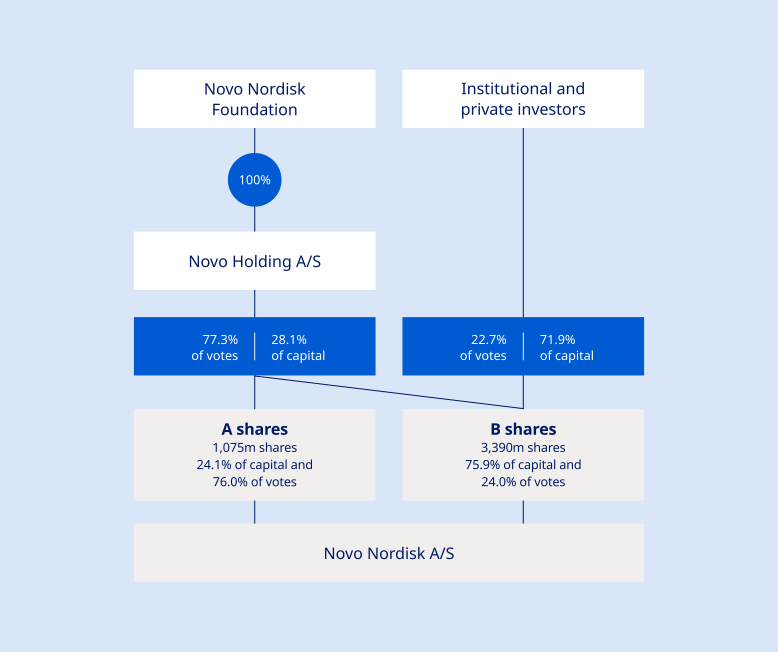
There is no complete record of all shareholders; however, based on available sources of information, as of 31 December 2025 it is estimated that shares were geographically distributed as shown in the ‘Geographical split of shareholders’ chart.
Geographical split of shareholders3
(% of share capital)
As of 31 December 2025, the free float of listed B shares was 94.13% (of which approximately 15.31% are listed as ADRs), excluding Novo Holdings A/S and Novo Nordisk’s holding of shares. As of 31 December 2025, Novo Holdings A/S and Novo Nordisk’s holding of B shares equaled 198,935,780 shares and had a nominal value of DKK 19,893,578. For details about the share capital, see note 4.3 to the consolidated financial statements on page 100 in the full Annual Report 2025 PDF.
1. Novo Holdings A/S’s registered address is Tuborg Havnevej 19, DK-2900 Hellerup, Denmark.
2. Treasury shares are included; however, voting rights of treasury shares cannot be exercised.
3. Split of shareholders is denoted according to the location of legal deposit-owners.
Capital structure
Novo Nordisk’s Board of Directors and Executive Management consider that the current capital and share structure of Novo Nordisk serves the interests of the shareholders and the company well. Novo Nordisk’s capital structure strategy offers a balance between long-term shareholder value creation and competitive shareholder return in the short-term.
In 2025, Novo Nordisk issued Eurobonds totaling EUR 10 billion. The total outstanding Eurobonds as of the end of 2025 amounted to EUR 16.3 billion. For details on issuance of Eurobonds, refer to note 4.6 in the Consolidated financial statements on page 104 in the full Annual Report 2025 PDF.
Dividend policy
The company’s dividend policy, which applies a pharmaceutical industry benchmark to ensure a competitive payout ratio for dividend payments, may be complemented by share repurchase programmes. The final dividend for 2024 paid in 2025 after the AGM in March was equal to DKK 7.90 per A and B share of DKK 0.10, as well as for ADRs. The total dividend for 2024 was DKK 11.40 per A and B share of DKK 0.10, corresponding to a payout ratio of 50.2%. The 2024 pharma peer group average was 58.9%.
In August 2025, an interim dividend was paid equaling DKK 3.75 per A and B share of DKK 0.10, as well as for ADRs. For 2025, the Board of Directors will propose a final dividend of DKK 7.95 to be paid in March 2026, equivalent to a total dividend for 2025 of DKK 11.70 and a payout ratio of 50.7%. The company expects to distribute an interim dividend in August 2026. Further information regarding this interim dividend will be announced in connection with the financial report for the first six months of 2026. Dividends are paid from distributable reserves. Novo Nordisk does not pay a dividend on its holding of treasury shares.
Share repurchase programme for 2026
For the next 12 months, Novo Nordisk has decided to implement a new share repurchase programme. The expected total repurchase cash value of B shares, for the 12 months beginning 2026, is up to DKK 15 billion. The total programme may be reduced in size if significant business development opportunities arise during 2026. Novo Nordisk expects to conduct the new share repurchase programme according to the safe harbour rules under the EU Market Abuse Regulation (MAR).
Share price development
Between the end of December 2024 and end of December 2025, Novo Nordisk’s share price decreased from DKK 624 to DKK 325, a decrease of -48%. The total market value of Novo Nordisk’s B shares, excluding treasury shares and Novo Holdings A/S shares, was DKK 1,037,935,269,555 as of 30 December 2025.
Share price performance 2025
Novo Nordisk share price and indexed peers4 (%)
5. AstraZeneca, Bristol-Meyers, Eli Lilly, GlaxoSmithKline, Lundbeck, Merck, Novartis, Pfizer, Roche and Sanofi.
Annual General Meeting 2026 |
|
26 Mar 2026 |
Ex-dividend, B shares |
|
27 Mar 2026 |
Ex-dividend, ADRs |
|
30 Mar 2026 |
Record date, B shares and ADRs |
|
30 Mar 2026 |
Payment, B shares |
|
31 Mar 2026 |
Payment, ADRs |
|
7 Apr 2026 |
Financial statement for the first |
|
6 May 2026 |
Financial statement for the first |
|
5 Aug 2026 |
Ex-dividend, B shares |
|
14 Aug 2026 |
Ex-dividend, ADRs |
|
17 Aug 2026 |
Record date, B shares and ADRs |
|
17 Aug 2026 |
Payment, B shares |
|
18 Aug 2026 |
Payment, ADRs |
|
25 Aug 2026 |
Capital Markets Day |
|
21 Sep 2026 |
Financial statement for the first nine months of 2026 |
|
4 Nov 2026 |
Financial statement for 2026 and Annual Report 2026 |
|
3 Feb 2027 |