
Risk management
Risk-taking is integral to our business, and we are exposed to both risks that are inherent to the pharmaceutical industry and specific to our business. 2025 has been an exceptional year, exposing Novo Nordisk to unprecedented geopolitical, macroeconomic and competitive pressures. Through systematic risk management, we have maintained a risk profile proportionate to our innovation ambitions and long-term commitments. While we do not compromise on product quality, business ethics, and safety of our patients and employees, we recognise that there are other risks that cannot be fully mitigated and must be accepted to enable business successes that make a difference and maximise societal value.
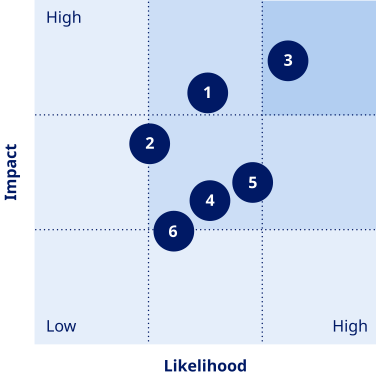
As part of our integrated approach to risk management, we identify, assess and mitigate risks across short and long horizons. This enables us to address risks to our short- and medium-term plans and risks that could hinder the longterm realisation of our corporate strategy. Executive Management and the Board of Directors review Novo Nordisk’s enterprise-wide risk profile quarterly, which focuses on the most significant risks based on likelihood and impact, including potential financial loss or reputational damage. Complementing this, sustainability risks from the double materiality assessment in the Sustainability statement are also considered.
The key risk themes below outline our broad areas of exposure, followed by key risks and mitigations, which detail specific risks, potential impacts and mitigation actions.
Key risks themes
Innovation and competition
Novo Nordisk is exposed to portfolio dependency with multiple brands relying on semaglutide as the active pharmaceutical ingredient. To remain competitive in the long-term and thereby mitigate the innovation risk, we invest in internal and external pipeline opportunities, as well as effectively attracting talent to continue providing patients with innovative treatments.
Geopolitical uncertainty
Conflicts, geopolitical tensions and social unrest represent a volatile landscape, leading to risks of trade restrictions. Most notably, the US administration continues to assess a range of trade actions affecting US imports, including tariffs and reference pricing measures which may continue targeting pharmaceuticals, with potential spillover effects to other countries. We navigate this uncertainty by monitoring developments, engaging in policy making and diversifying our supply chain.
Healthcare reform
Some governments are adopting changes to their pharmaceutical frameworks, increasing system complexity and regulatory uncertainty. This may increase price pressure and affect profitability. We continuously educate healthcare providers about the value and benefits of our products and engage with policymakers and stakeholders, to communicate potential consequences of healthcare reform to the innovative life science environment.
Commercialisation
Complex market dynamics and intensified competition from branded and generic competitors and compounders lead to risks of price pressure, lowered sales volumes and supply rebalancing. We address this by generating robust clinical and real world evidence to substantiate product value and negotiating with payers to secure access and reimbursement. In parallel, a more consumer driven market introduces risks related to direct to consumer marketing, new capability requirements and brand reputation. We manage these risks by investing in consumer engagement, telehealth channels and partnerships, building necessary competencies and actively monitoring consumer trends.
Production capacity and supply chain risks
Demand fluctuations, resource shortages, geopolitical instability, trade disputes and local manufacturing requirements strain global supply chains. Furthermore, expanding production capacity is complex and associated with long lead times. We continuously evaluate and manage investments in our production capacity and supply chain to mitigate this risk.
Access and affordability
Access to affordable care is a global issue as healthcare systems struggle to provide quality care at a sustainable cost, while the burden of chronic diseases keeps rising. Ensuring access and affordability is a risk and responsibility Novo Nordisk shares with all stakeholders involved in healthcare. We continue to scale capacity to meet patient demand, broaden access to medicines and meet our social responsibilities.
Digital disruption
New digital technologies offer opportunities to deliver greater value and improve patient outcomes but also risk disruption by intensifying competition through accelerated and enhanced drug discovery and development. To remain competitive, we continuously innovate and integrate these technologies into our processes.
Ethics and compliance
Our commitment to ethics and compliance remains central to our operations. This is essential to navigate a rapidly evolving regulatory landscape, which may affect product approvals, market access, pricing and product liability. Our values, encapsulated in the Novo Nordisk Way and our code of conduct, guide every decision we make and enable us to maintain integrity, adhere to ethics and compliance standards and fulfil our purpose effectively.
Environmental impact
Novo Nordisk’s expansion efforts significantly increase our greenhouse gas emissions. We address this challenge through our Circular for Zero strategy. This includes an increased focus on our global emissions, encompassing scope 3 emissions, as well as assessing, monitoring and mitigating environmental risks across the value chain.
Key risks and mitigations
Risk grid (illustrative)
Risk area |
|
Description |
|
Impact |
|
Mitigating actions |
||
|---|---|---|---|---|---|---|---|---|
|
|
Research and clinical pipeline risks |
|
Findings in clinical activities, regulatory processes or misjudging of commercial potential, leading to delays or failure of products in the pipeline. |
|
|
|
|
|
|
Product supply, quality and safety risks |
|
Higher-than-expected demand or disruption of product supply due to, e.g., geopolitical instability or quality issues, may compromise product availability, ultimately impacting patients and representing a lost commercial opportunity. In addition, there could be risks related to safety and product liability. |
|
|
|
|
|
|
Commercial-isation risks |
|
Competitive pressures and market dynamics (e.g., generics and compounding), as well as geopolitical, macroeconomic or healthcare crises, reduce payer ability and willingness to pay and ultimately lower prices and volumes. |
|
|
|
|
|
|
IT security risks |
|
Disruption to IT systems, such as cyber-attacks or infrastructure failure, resulting in business disruption or breach of data confidentiality. |
|
|
|
|
|
|
Financial |
|
Exchange rate fluctuations (mainly in USD, CNY and JPY), geopolitical risks (e.g., tariffs), disputes with tax authorities and changes to tax legislation and interpretation. |
|
|
|
|
|
|
Legal, patents and compliance risks |
|
Breach of legislation, industry codes or company policies. Competitors asserting patents against Novo Nordisk or challenging patents critical for protection of commercial product and pipeline candidates. |
|
|
|
|


